

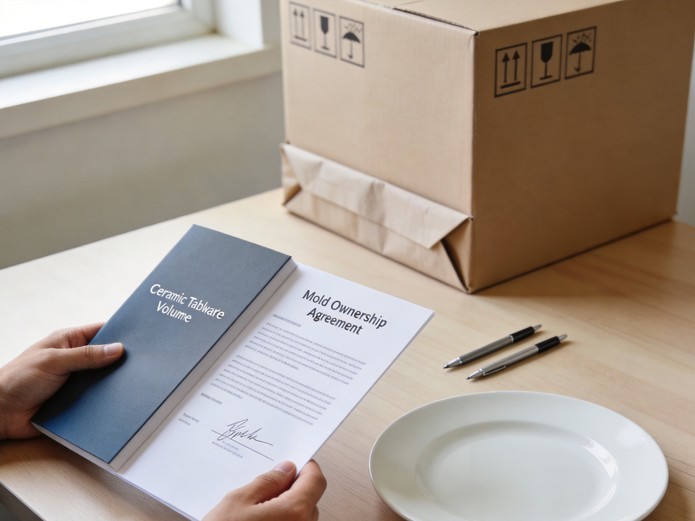
Ceramic tableware design protection is not a document you sign once. It is a set of controls that must survive years of contact with a factory running your mold, your decal film and your artwork. The clause that decides most outcomes is not the confidentiality paragraph but the production-volume paragraph. If your order says 5,000 pieces and the kiln yields 5,180, who owns those 180 is settled by the contract, not by goodwill.
This covers five routes a buyer-owned design takes out of a plant, the three legal objects you may own, the clause text worth arguing over, and the one border mechanism that turns a contract breach into a refused entry.
Five Routes a Buyer-Owned Design Leaves the Plant
Most buyers think leakage means a competitor copying the plate. More often it is duller: the factory holding your mold and film sells a batch you never ordered. Same shape, glaze and mark, different legal hook.
| Route | What it looks like | Legal object it touches | Where it can be stopped |
|---|---|---|---|
| Volume overrun | Extra pieces from the same kiln run, right glaze and mark, in neutral cartons | Trademark (genuine mark, applied by your contractor) | Volume clause + customs recordation |
| Seconds diversion | Units you rejected for a glaze pinhole, sold as first quality | Trademark + retained sample | Destruction clause + batch coding |
| Mold reuse | Your shape on another body, sold to a different buyer | Registered design right + contract | Design registration + mold reconciliation |
| Artwork reuse | Your crest on another plate, or your film in a printer’s drawer | Copyright in the artwork + physical custody | File return clause + decorator audit |
| Sub-supplier hand-off | Decal or bisque made in a workshop you never approved | Contract; in China, also facilitation liability | Named sub-supplier ban + audit right |
You May Own Three Things, and They Do Not Travel Together
Buyers treat “the design” as one asset. It is three, under three regimes, and closing one gap closes none of the others.
The mold is a physical tool. If you paid for it you own it as property, and enforcement is contractual and possessory: demand it back or demand it destroyed, and count it. The artwork — vector file, decal film, screens — is a copyright work and a physical object. Owning the copyright stops reproduction in principle; holding the film stops it in fact, which is why a return clause matters more than most IP language.
The shape is where buyers are weakest, because shape is not protected automatically. In China a design patent runs fifteen years from filing under Article 42 of the Patent Law (2020 revision, in force 1 June 2021), and Article 11 bars anyone from making, offering for sale, selling or importing a patented design product for business purposes without a licence. Article 64 fixes scope by the images in the grant, not your CAD file. That reaches the factory itself, which a contract claim cannot.
Only the trademark reaches a border. Build the file around that asymmetry. The wider commercial terms sit in the purchase contract terms, and new tooling starts with OEM and ODM development.
What the Volume Clause Has to Say, Word by Word
One sentence carries most of the weight: the purchase order quantity is the entire authorization, and any piece above it is unauthorized whether or not it carries your mark. Factories plan kiln loads, not single pieces, so a small structural excess is real industry practice — and the clause decides in advance what happens to it.
| Parameter | What the clause should say | What a weak supplier offers |
|---|---|---|
| Authorization ceiling | “Supplier is authorized to produce and mark the Order Quantity only. Any excess piece is unauthorized and shall not be marked, packed or shipped.” | “Standard overrun of up to 5% may apply.” |
| Overrun disposition | Zero tolerance above the order quantity; destroyed with a signed certificate, or invoiced at the contract unit price with prior written consent. | “We will keep them for your next order.” |
| Seconds and rejects | No rejects or off-grade units sold, gifted or shipped under the mark; destroyed or de-identified, with a count that reconciles to the inspection report. | “We sell them locally without your logo.” |
| Mold register | Sets issued, declared output life per set, and reconciliation of sets consumed against pieces produced. | “The mold is ours to maintain.” |
| Artwork custody | All artwork files, decal film and screens returned or destroyed and certified at program end, with no retention for samples or archive. | “We keep the film in case you reorder.” |
| Sub-suppliers and audit | No decoration, bisque or packing subcontracted without named written approval; audit right to mold store, decal store, kiln records and shipping documents on stated notice. | “Quality issues can be discussed during your visit.” |
| Survival | Volume, artwork and non-use obligations survive termination for a stated term and bind successors. | Silence. |
Audit Arithmetic That Reaches the Kiln
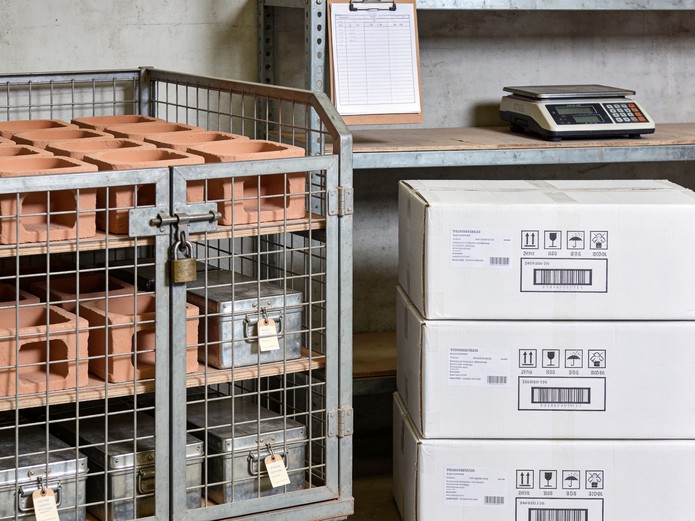
Visiting a factory is not an audit. An audit produces a number that should not exist. Three reconciliations catch nearly everything without trusting a summary.
First, mold consumption against output. Have the supplier declare, at tooling sign-off, the output life of one cavity set from their own records. At program end, count sets consumed and divide pieces delivered by sets consumed. A figure meaningfully above the declared life means production you did not order, on molds you paid for — and it is the supplier’s own number, hard to argue with later.
Second, film and screen inventory: film is consumed per impression, so 1,000 pieces against film cut for 2,000 means the second thousand is a reorder or a leak. Third, carton-level coding: every master carton carries a PO number and run code, and the packing list reconciles cartons to pieces at loading. Uncoded neutral cartons are the clearest signal a batch was made for someone else.
| Field to count | Source document | What the number proves |
|---|---|---|
| Molds issued vs molds present | Tooling handover record, mold store count | Whether tooling has left the building |
| Cavity sets consumed vs pieces delivered | Supplier’s declared output life per set | Whether production exceeded the order |
| Film impressions cut vs pieces marked | Film issue and return log | Whether decoration ran past the order |
| Kiln records vs order runs | Kiln log for the PO period | Whether the shape was fired when you were not buying |
| Scrap count vs inspection report | Inspection report, scrap bin, destruction certificate | Whether rejects were destroyed or diverted |
| Cartons and codes vs packing list | Packing list, carton labels, loading photos | Whether shipped volume matches the order |
The Border Is the Only Place a Clause Becomes Physical

A contract breach produces a claim; a recorded trademark produces a container that does not enter. For a US-bound buyer the mechanism sits in 19 U.S.C. §1526 and 19 CFR Part 133, and it reaches overruns precisely because the mark on them is genuine.
Recordation is administrative. Section 133.3(b) sets the fee at $190 per trademark per class — $570 for a mark in three classes. Section 133.4(b) runs it concurrently with the 20-year registration period; §133.7 renews it within three months of expiry at $80 per class.
The filing content is where buyers leave value behind. Section 133.2 requires the places of manufacture, the name and address of each foreign person authorized or licensed to use the mark, the use authorized, and any parent, subsidiary or commonly controlled company using it abroad. Listing your factory as an authorized user feels like weakening your position; it does the opposite, making the overrun what §133.23(a) calls a restricted gray market article — goods bearing a genuine mark identical or substantially indistinguishable from one owned and recorded by a US person, imported without that owner’s authorization, expressly including marks applied by an independent licensee, “including a manufacturer.” Such goods are denied entry under §133.23(c), detained 30 days from presentation under §133.23(d) so the importer can try to establish an exception, and seized under §133.23(f) if release is not obtained inside that window.
That is the part buyers miss. An overrun is not counterfeit: the mark is real, applied under your own contract, which is why §133.23 and not §133.21 is the instrument. Section 133.21 handles suspected counterfeit marks — detention up to 30 days, notice to the importer within five business days of the detention decision, a seven business day window to show the mark is not counterfeit, then disclosure of unredacted photographs to the recorded owner. Two tracks, two clocks, two evidence files.
The EU answers a different question. Directive (EU) 2015/2436 Article 15(1) exhausts the right when goods are put on the market in the Union; Regulation (EU) 2017/1001 Article 15(1) exhausts the EU trade mark on placement in the EEA, a wider circle than the EU-27. Article 15(2) of both preserves the right to oppose further commercialisation for legitimate reasons, especially where the goods’ condition changed or was impaired after placement — so which right you rely on changes the answer for a first sale outside the EU-27.
In China exposure is administrative and criminal, not border-based. Article 57 of the Trademark Law covers selling infringing goods and unauthorized making or selling of marks. Article 60 provides confiscation and destruction of the goods and the tools that made them, fining up to five times illegal turnover where it reaches ¥50,000, and up to ¥250,000 where it does not. Implementing Regulations Article 75 treats warehousing, transport, printing and online marketplaces as providing facilities. The 2025 Supreme People’s Court interpretation sets criminal thresholds at ¥30,000 of illegal gain or ¥50,000 of sales value — not your damages remedy, but why a factory’s compliance officer takes the clause seriously. None of this is legal advice.
Three Mistakes That Reopen the Leak, and What Overruns Cost
The first mistake is treating a non-disclosure agreement as protection. An NDA gives you a claim after disclosure; it does nothing about pieces already in a warehouse and rarely gives a border remedy. The second is recording the mark after the first leak: recordation is slow relative to a container, and the Part 133 windows assume an owner already on file. File during tooling.
The third is moving decoration to a destination decorator: units leave the plant unmarked, an overrun becomes invisible white-label stock, and the trademark hook disappears.
| Choice | Unit cost | MOQ and lead time | Traceability if something leaks |
|---|---|---|---|
| Mark fired at the factory (in-glaze) | Highest | Higher MOQ, longer kiln schedule | Strong: batch-coded, marked, covered by a recorded mark |
| Decal applied at destination | Lower | Lower MOQ, shorter lead time | Weak: plant output is unmarked and cannot be tied to your order |
| Unmarked white-label supply | Lowest | Lowest | None |
| Destruction certificate for excess | No unit cost; tooling fee may rise | One witnessed step, not extra days | Closes the overrun channel, not chases it |
Overruns cost in ways the invoice never shows. Quality exposure is worst: the overrun comes off the same kiln setting, so it is often indistinguishable from first quality. Price exposure follows, because a leaked unit at a deep discount resets what distributors expect to pay. Put those parameters into the specification sheet and the quality baseline into the defect classification standards so a later dispute has a defined object. Buyers sourcing the shapes themselves usually start from commercial plates and platters or hotel and catering dinnerware.
Choosing a Supplier Who Will Honour the Clause
A clause is worth what the counterparty’s systems support. Three signals tell you before you sign whether the volume and artwork terms survive year three.
Ask for the mold register as a document, not a description: a supplier tracking cavity sets and output life already runs the arithmetic you intend to run. Ask what happens to rejects, in numbers — “we destroy them” without a certificate describes a habit, a named signatory and a form describe a control. Ask who prints the decal: if it is a workshop rather than a department, your artwork has left the building already. Score these answers as you score capacity and price; the supplier audit checklist covers the wider assessment.
- Mold register exists, with declared output life per cavity set.
- Reject disposition has a named signatory and a certificate form.
- Decoration is in-house, or sub-suppliers are named in an annex.
- Cartons carry PO and run codes as standard, not on request.
- Artwork files and film are returned at program end, in writing.
- Recordation lists the factory as an authorized user.
- Survival period after termination is stated in years.
Frequently Asked Questions
Does buying the mold give me the design? No. Paying for a mold transfers property in the tool, not rights in the shape. Stopping another party from making the shape needs a registered design right and, in most markets, a mark to reach the border.
Is an overrun the same as a counterfeit? No, and the distinction decides the remedy. The mark is genuine, applied by your own contractor, placing it under 19 CFR §133.23 rather than the counterfeit rule in §133.21 — different evidence, different clocks.
Is a trademark enough, or do I need a contract too? Both, at different layers. The contract binds the factory and allocates tooling and files; the recorded mark governs the container at the border, where your counterparty is absent.
How do I prove a factory ran extra pieces? Reconcile three counts: cavity sets consumed against pieces delivered, film impressions against pieces marked, and cartons against the packing list. Each yields a number that should not exist if the order was honoured.
What should the destruction clause require? A count, a method that makes the units unusable as tableware, a named signatory, a dated certificate, and photographs. A promise to destroy is not evidence of destruction.
Does EU law help if the goods were first sold outside the EU? It depends on the right. Directive (EU) 2015/2436 exhausts on placement in the Union; Regulation (EU) 2017/1001 exhausts on placement in the EEA, which extends past the EU-27. Take advice before structuring around that.
If you are about to pay for tooling, the next step is not another NDA. Send the shape, the decoration route and the target volumes, and ask for a feasibility review covering the mold register and the reject disposition in writing. Submit your design for a feasibility review and we will tell you which of the five routes your file leaves open.
Buyers comparing suppliers can carry these items across the vendor scorecard unrenumbered, or see the private label programme if the design is still developing.


